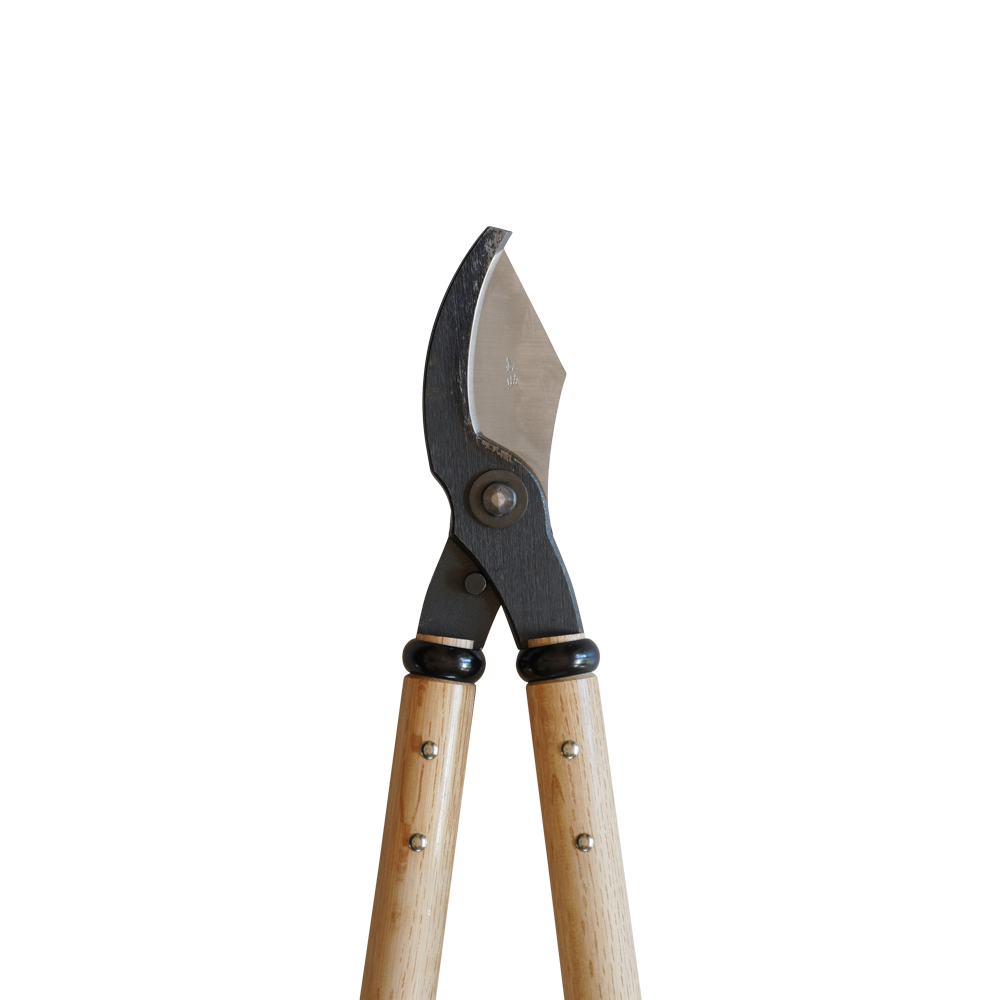
Loppers
Loppers
Garden loppers are used for cutting branches up to 2.5cm, less for harder wood species – please apply common sense when pruning. Cut bigger branches at a 45 degree angle.
Do not rely on the handles to do the cutting – they are wood and can snap with too much lever pressure. The handle length is designed for reach, not leverage.
Couldn't load pickup availability
Share
{Maker/Brand}Maker
Ikarashi Hamono
{Maker/Brand}Origin
Niigata Prefecture, Japan
{Maker/Brand}Stock Keeping Unit
A-12
{Specifications}Measurements
450mm (handle)
{Specifications}Material(s)
58C (high carbon steel)
{Specifications}Handle
Oak (vanished)
{Information}Care Instructions
Care and Maintenance Instructions: Secateurs, Shears & Loppers
High quality tools are optimised for the specific task they were designed to perform - so care is required to ensure a long life.
The above garden tools at Phillip & Lea are made of carbon steel – as they offer superior edge retention and ease of sharpening. Because the tools are made of carbon steel they do require oiling to avoid corrosion. Japanese traditionally use Camellia (Tsubaki) Oil to protect their carbon steel cutting blades. Other suitable oils (e.g. sewing machine oil) may also be used.
Ensure the blade is clean and dry before applying Camellia Oil. Simply wipe the blade with a clean cloth impregnated with Camellia Oil. Re-apply after each use or when the film of the oil has worn away. Phillip & Lea stocks Camellia Oil in 100ml (dropper) and 250ml (spray) bottles.
Any signs of corrosion can be removed with a Rust & Sap Eraser. Phillip & Lea stocks both small and large Rust & Sap Erasers.
Regularly remove sap from the blade to avoid build-up. We recommend (and stock) cleaning with Yanipika Tool Cleaner Spray. A Rust & Sap Eraser can be used to remove any build-up of sap.
Always cut from the base of the blades. Cutting with the tips of the blades may cause damage. Do not twist or apply uneven pressure. Do not cut wire, metal, stone, plastic or any other hard material. Even bamboo fibres and some very hard woods, especially knots and burrs, can damage the edge.
The blades can be sharpened attached or separated (the tools have a centre bolt that can be unscrewed). We strongly recommend sharpening your blades with a natural or ceramic stone. Phillip & Lea stock 180grit, 500grit and 1000grit ceramic stones that are specifically designed for secateurs, shears & loppers. Phillip & Lea also offers a sharpening service.
If you are going to sharpen your own blades, and this is a new activity, we advise you spend some time researching sharpening before commencing. It is an excellent skill to have, but it’s important you understand the technique and the role of stone grits.
Treat any unvarnished handle with boiled linseed oil annually (or more frequent if conditions dictate) - to avoid the handle from drying out and becoming brittle. Phillip & Lea stocks 250ml and 500ml bottles of Linseed Oil.
For Tobishio products, Phillip & Lea stock replacement springs and centre bolts. For Kuroco products, Phillip & Lea stock replacement springs
A special note:
Double edge cutting tools, such as shears and clippers, are designed to cut foliage and green stems only.
Single edge cutting tools, such as secateurs and loppers, are used to prune branches and woody stems. Each single edge cutting tool will have a limit as to the diameter it can cut. The limits are outlined on the product pages of our online store. There is a caveat to these limits - particularly for loppers due to the length of its handles. Wood can be very hard. If there is an uncomfortable resistance while cutting, then desist immediately. If you strike this situation then move up to the next tool in the hierarchy – the hierarchy being secateur, lopper and pruning saw. The blades should move through a branch or woody stem smoothly, with only minimal resistance.