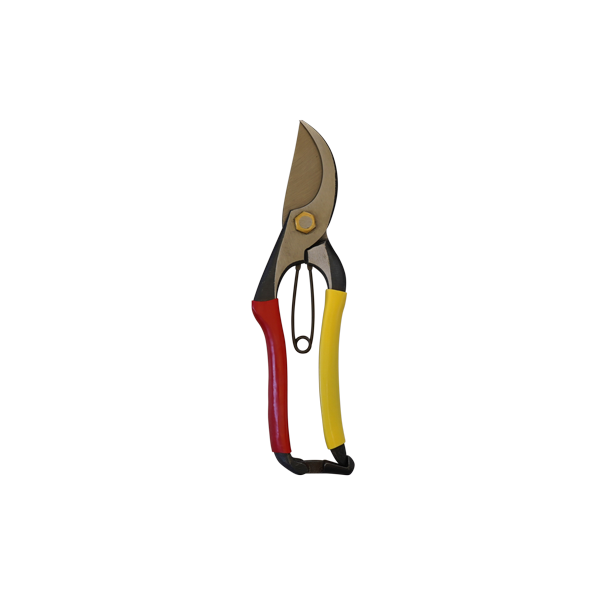
No.20 200mm SR-1 Left-handed Pruning Secateur
No.20 200mm SR-1 Left-handed Pruning Secateur
Tobisho is a Japanese master blacksmithing forge that creates high-quality, handmade pruning shears and garden scissors that are highly rated by professionals both in and outside of Japan.
Secateurs are used to prune the thinner branches and dead wood of trees and shrubs. Use a lopper or pruning saw for pruning thicker branches and dead wood.
These secateurs are made of high carbon steel, which means they are extremely sharp and have great edge retention.
Each handle is covered in a red and/or yellow grip. This makes the handles easier to grip and easier to find if left in a garden bed!
Couldn't load pickup availability
Share
{Maker/Brand}Maker
Tobisho
{Maker/Brand}Origin
Yamagata Prefecture, Japan
{Maker/Brand}Stock Keeping Unit
LS-1
{Specifications}Measurements
20cm (length) x 6cm (blade length)
{Specifications}Weight
0.25kg
{Specifications}Material(s)
S60C (Carbon steel)
{Information}Care Instructions
The blades are made of high carbon steel. High carbon steel blades must be treated to avoid rusting. Japanese traditionally use Camellia (Tsubaki) Oil to treat high carbon steel tools. Other suitable oils may also be used. Ensure the blade is clean and dry before applying Camellia Oil. Simply wipe the blade with a clean cloth impregnated with Camellia Oil. Re-apply after each use. Although the blades of Tobisho secatuers, shears, pruners and clippers are made of hardened steel, they're not impervious to misuse. Only use for the specified activity on this page. Do not cut wire, metal, stone, plastic or any other hard material. Even bamboo fibres and some very hard woods, especially knots and burrs, can damage hardened steel edges. Dropping the tool onto a hard surface may cause the blade to break. Do not twist or apply uneven pressure. Cutting should occur along the section of the edge(s) closest to the handle. Cutting at the point or tip runs the risk of snapping the blade.
Related Products
Related Product
Related Product
Related Product
Related Product
Related Product
Related Product
Related Product